Covert action diplomacy
The operational arm of the State Department has intertwined its counter-narcotics work with CIA covert action for decades and is openly supporting “clandestine lab raids” in Mexico.


“High value target apprehension, clandestine lab raids, VIP protection, tactical planning,” read a summary of a public job posting on a special operations forum last month, recruiting current and former American special operations forces and tactical police to “design and deliver advanced tactical training to Mexican law enforcement and special operations units.” “Based in Mexico City with travel to operational sites, including stays on Mexican LE/military bases,” continued the pitch from SGI Global, a Virginia-based contractor founded in 2008 by two former DEA operations chiefs.
Notwithstanding the focus on “clandestine” special operations, the job ad was through an operational arm of the U.S. State Department informally known as the ‘drugs and thugs’ bureau, but formally known as the Bureau of International Narcotics and Law Enforcement Affairs (INL). The listed program manager for the ad, David Kraus, did not respond to a request for comment, but public contracting records show that SGI Global is currently executing a two-year, $10.5 million support contract for INL in Mexico City, as part of a broader four-year initiative.
Following the revelation that two CIA officers were killed in Mexico in April while dressed in the uniform of the Chihuahua State Investigative Agency, CNN in May reported an escalation of clandestine CIA-assisted counter-narcotics operations inside of Mexico, including targeted assassinations against cartel members. One day later, another Virginia contractor began executing an INL delivery order to provide roughly $230,000 in night vision goggles to “Mexico’s elite Navy special forces unit (UNOPES).”
(INL this month also advertised its intent to noncompetitively award the Tennessee-based wiretapping technology company PenLink with a contract to set up a wiretapping room for the Mexican government.)
Formally established as the Bureau of International Narcotics Matters (INM) during the Carter administration, with a mission of reducing the flow of foreign narcotics into the United States, the organization grew out of the Nixon administration’s War on Drugs. Perhaps the most controversial leader of Nixon’s predecessor to the INM was the White House ‘plumber’ Egil M. Krogh, who served as a director of the Cabinet Committee on International Narcotics Control (CCINC).
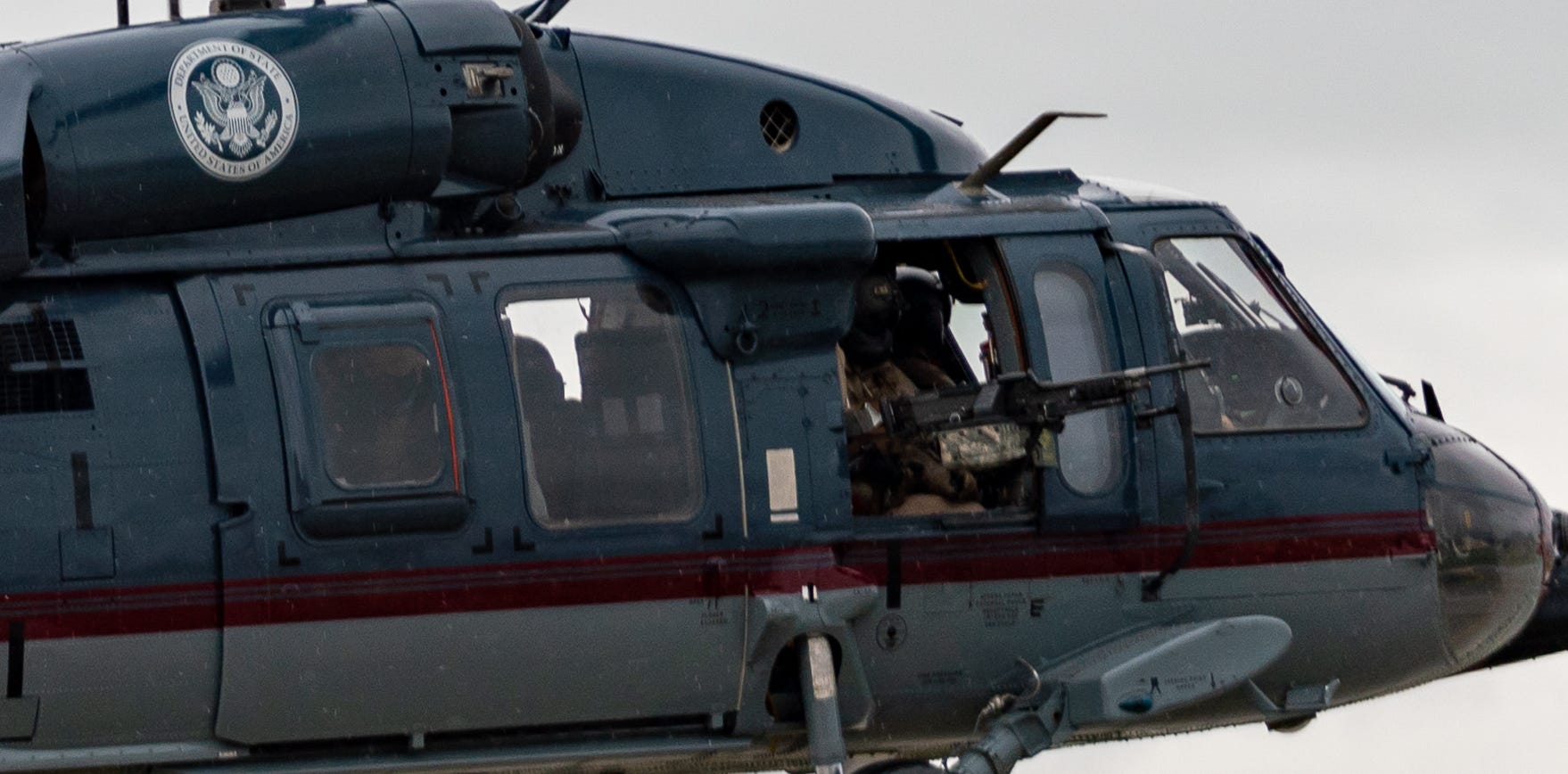
Operating with a roughly $1.4 billion yearly budget which has historically paid out billions of dollars each to the private military contractor DynCorp and its airlift competitor AAR Corp, INL also operates the U.S. State Department’s private international air wing of more than 200 aircraft, including Black Hawk helicopters, Dash 8 planes, and drones. The primary mission of the air wing is drug crop eradication and narcotics interdiction, most famously in relation to the “Plan Colombia” coca-eradication campaign, though public contracting documents have revealed secondary focuses on tasks such as “pipeline security, border patrol, and other security activities.”
More recent activity in this vein include a market research notice last month for 150 M2 heavy machine guns which INL hopes to supply to the Ukrainian government “to provide direct support to the mobile firing teams against airborne threats.”
Perhaps the most contentious INL activity arose from its central role alongside the CIA’s Crime and Narcotics Center and Latin America Division in the Peruvian Air Force mistakenly killing the American Baptist missionary Veronica Bowers and her newly adopted infant daughter Charity with a .30-cal machine gun on April 20, 2001, resulting in a roughly two-year pause in the so-called Air Bridge Denial Program.
Though the U.S. support for lethal takedowns of civilian aircraft in the Andes region was only possible as a result of a decision made by President Clinton on June 21, 1994, responsibility has also been assigned to Jose A. Rodriguez Jr., who served as deputy chief of the CIA’s Crime and Narcotics Center until October 1995, when he took charge of the Latin America Division.
A memoir published last year by Clinton-era INL South America Division chief Ralph M. Buck recounted both his role in getting legal sign-off for the Air Bridge Denial Program from an assistant U.S. attorney general and the usage of “machine guns on [INL] helicopters to fire back” at armed coca producers.
Clinton’s rebranding of the CIA’s Counternarcotics Center as the Crime and Narcotics Center in 1994 further loosely coincided with the June 1994 expansion of the mandate of the Bureau of International Narcotics Matters (INM) into organized crime in Europe; financial analysis and anti-money laundering became the unifying theme for INM’s rebranding the next year as the Bureau of International Narcotics and Law Enforcement Matters (INL). (INL’s major aviation contractors, DynCorp and AAR, have nevertheless paid tens of millions of dollars in fines for bribing government officials and inflating costs.)
The obituary for INL air wing founder John A. McLaughlin – who caused a stir around the time of his 2003 retirement by arguing for the Justice Department to absorb the INL air wing – further noted that his organization “was tasked in 1999 to stand up an assault helicopter battalion within the Colombian Army.” According to the same obituary, following the U.S. invasion of Afghanistan, McLaughlin was in 2002 “tasked to stand up a border security operation on the Pakistan-Afghanistan border,” which was further described as “a joint host nation/USG aviation program to stop the flow of illegal arms, drugs, and personnel crossing freely between the two countries.”
"We don't differentiate between contractors, Foreign Service, Civil Service and Department of Defense services," stated McLaughlin in an interview for the January 2001 edition of the U.S. State Department’s magazine, adding that, "We promote and enjoy the 'One Team, One Fight' concept."
Prior to former CIA LAD division chief Rodriguez’s rise to operations chief in late 2004, where he infamously ordered the destruction of video evidence of CIA torture at a black site in Thailand, Rodriguez led the agency’s Counterterrorism Center (CTC) for a roughly 30-month period beginning in 2002. Rodriguez’s covert activity again collided with INL through the CTC’s rendition flight program, which was at least partially managed by DynCorp under cover as a U.S. State Department aviation program.
Widely reported court filings first noticed by the nonprofit Reprieve revealed that DynCorp had subcontracted rendition flights to the New York-based luxury flight company Richmond Aviation circa 2002 through 2003, using letters nominally signed by State Department administrative assistant Terry A. Hogan. According to one note provided to Richmond, the rendition flights were “global support for U.S. embassies worldwide.”
It appears to have gone largely unnoticed that DynCorp’s cover for the rendition flights was similar to a real multi-billion dollar program. At the time of its execution of rendition flights using INL cover, DynCorp was fulfilling a roughly 12-year “Worldwide Aviation Support Services” (WASS) contract with INL which issued its first child award by August 2000.
According to an unsuccessful lawsuit DynCorp filed against the U.S. Government in 2016 in relation to its loss of the multi-billion dollar WASS contract to the airlift company AAR Corp., 70 of the 87 names of fallen INL employees and contractors listed on INL’s Memorial Wall as of its June 2014 dedication were DynCorp personnel, and 18 were “Killed-in-Action on the WASS program.”
DynCorp further entrenched its relationship with the CIA in late 2018, hiring former counterintelligence chief Mark E. Kelton as a senior vice president. After the company was acquired by the Chantilly-based Amentum Services in 2020, Amentum likewise hired former CIA operations chief David Marlowe as a vice president in late 2023.
Between Amentum’s acquisition of DynCorp and hiring of Marlowe, the company in late 2021 began acquiring the Fallschurch-based Pacific Architects and Engineers (PAE), resulting in Amentum Global Services taking over an ongoing, roughly 8.5-year, $341 million contract with INL to supply helicopter and fixed-wing support services to the Colombian National Police (CNP).
One such INL Black Hawk was destroyed in what was reported to be a drone attack in the Antioquia region of Colombia on August 21, 2025, killing 13 CNP officers. INL also announced its intent to provide the controversial facial recognition platform Clearview AI to the CNP’s Directorate of Protection and Special Services (DIPRO) in June, as first reported by this publication. And perhaps the largest INL grant payout the last year has been to the Williamsburg-based National Center for State Courts, which received an additional $10 million last month for supporting the INL section of U.S. Embassy Bogotá.
INL’s law enforcement mandate also resulted in a potentially $2.8 million “gold traceability” contract with to the Florida-based Global Venture Consulting late last month, in support of the INL sections of the U.S. embassies in Suriname and Guyana. The award follows an $800,000 INL grant to the Brazilian branch of Transparency International last year to “combat illegal gold trafficking in the Amazon” and years of providing millions of dollars in funding to investigative journalism organizations such as InSight Crime, The Center for Advanced Defense Studies (C4ADS), and the Organized Crime and Corruption Reporting Project (OCCRP).
***
INL contracts have also followed the rise of the U.S. Government’s Haiti Gang Suppression Force (GSF), which has operated in loose coalition with the Haitian government’s tasking of Erik Prince’s private military contractor Vectus Global to conduct lethal drone strikes, which have been criticized for killing civilians. INL began acquiring AI detection platforms produced by the Lehi-based Converus in March as part of a surge to hire thousands of members of the Haitian National Police. This month, INL further began solicitations for freight forwarding in support of the GSF, including for “ammunition” and “aircraft parts.”
The McLean-based Strategic Capacity Group – co-led by former 1st Special Forces Group commander Russell D. Howard – has also received nearly $7 million in grants between May and July to support the Caribbean Basin Security Initiative (CBSI) and the El Salvador branch of INL’s International Law Enforcement Academy (ILEA) network. (The first ILEA branch opened in 1994 in Budapest and is led by the FBI.)
In addition to the Operation Southern Spear campaign of U.S. military strikes on fishing vessels in the Caribbean and eastern Pacific Ocean which began on September 2, 2025, the CIA was reported by The Washington Post on Thursday to be behind an additional campaign of drone attacks on Ecuadorean fishing vessels near the Galápagos Islands. Victims described attacks from armed quadcopters followed by being “taken aboard a nearby ship, hooded and cuffed by armed men, and transported to El Salvador,” in the words of The Post.
An American Cessna Citation Longitude aircraft with callsign “FENIX 701” which was identified by The Post as likely providing surveillance support to the boat strikes was further reported by the independent journalist Seth Hettena to have the registration number N883EE.
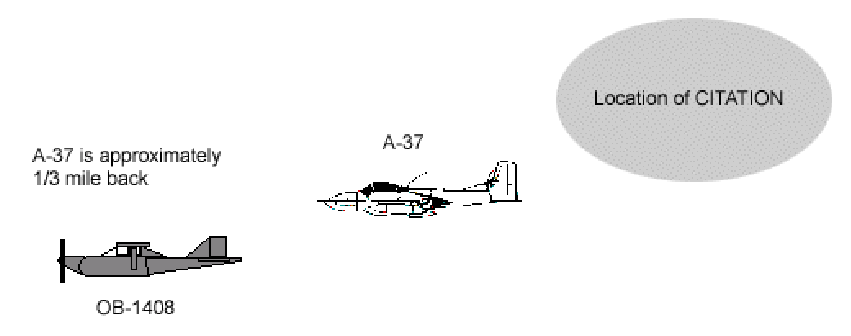
The analogous surveillance role of a jointly American and Peruvian-crewed Cessna Citation in the fateful April 20, 2001 shootdown of the Bowers family was detailed in an August 2, 2001 report published by INL in collaboration with the CIA, complete with a diagram of the Citation’s position relative to the Peruvian Air Force A-37 interceptor.
 | A guest post by
|