Info warfare contractor escalated to publishing its encrypted group chats
British former SCL exec published his group chats with CEO of American info warfare contractor MSI as part of ongoing legal battle over the profits from covert acquisition by Premise Data in mid-2022.

As part of an ongoing legal demand for an addition $4 million in payouts from a mid-2022 covert merger between two American information warfare contractors, the two silent British partners, Alexis Everington and Richard White of the UAE-based International Advisory Services (IAS), escalated to publishing their group chats on the encrypted communications platform Wire. The net effect is to shed light on the real and proposed financial relationships between intelligence-focused U.S. special operations contractors.
The new disclosures came one day after this publication’s last report on the ongoing legal battle between Everington and the CEO of the Texas-based information warfare contractor Madison Springfield Incorporated (MSI), whose covert acquisition by the San Francisco-based gig-work information collection firm Premise Data in mid-2022 continues to be redacted from the court filings.

The contentious relationship between Everington and Riesen began in 2011 as an offshoot of Everington’s work across the Middle East while director of operations of the controversial British information operations firm Strategic Communication Laboratories (SCL), whose American branch was later known as Cambridge Analytica. SCL was a subcontractor under the Tampa-based Archimedes Global, where Riesen was previously chief operating officer, and MSI was originally planned to serve as a three-way partnership between Riesen, Everington, and fellow former SCL-staffer Richard White to continue their information operations collaboration.
“To compete for and complete secretive United States defense contracts, Everington and White each had their own priceless contacts only known to them in various foreign countries,” stated an opening paragraph in Everington and White’s amended complaint against Riesen on Tuesday. “The combined knowledge of Everington and White created a network of intelligence gathering for the United States government and client,” the complaint continued, adding that, “Gathering intelligence information was done by a process known as stove piping […] creating a dynamic to protect the identity of people not only on the ground doing research and obtaining the information, but also for the protection of Everington and White.”
Exhibit 9 from the complaint includes an abbreviated curriculum vitae for Everington in late August 2014 in relation to his work with U.S. Special Operations Command (SOCOM), listing his “survey data collection efforts in semi- and non-permissive research environments through indigenous research networks” as spanning the countries of “Yemen, Libya, Syria (2014), Jordan (2013), Iran, Syria (2013) and Libya (2011).”
(As reported by this publication earlier this month, Everington’s role as an executive at IAS and MSI was simultaneous to his role as a strategic communications advisor to the Cairo-based women’s rights nonprofit Karama, which published photos to the platform Flickr of Everington providing communications training in countries including Jordan, Libya, and Yemen.)
“In essence, while Riesen was the face of Madison Springfield to existing and potential customers in the United States, [Everington and White] were the backbone of the company working on obtaining intelligence on the ground level in foreign countries,” stated Tuesday’s amended complaint. “On the ground consultants often required to be paid up front due to the sensitive nature of the work being performed,” the complaint continued.
The complexity of the legal battle between the UAE-based IAS and the American firms Premise and MSI — each a significant (sub)contractor on information operations with SOCOM — further increased earlier this month, when Premise and MSI were sold to a fourth special operations contractor, the Alexandria-based Culmen International. Culmen, which has specialized in acquiring foreign weapons and ammunition for SOCOM, attempted to preserve the confidentiality of Premise’s ownership of MSI by separating its press releases regarding the two companies by 13 days.
“Plaintiffs have learned that Madison Springfield was recently acquired by another company and is no longer part of the original acquiring company from 2022,” stated a footnote in Tuesday’s amended complaint, emphasizing that “this new acquisition is relevant to an accounting of Riesen’s assets.”
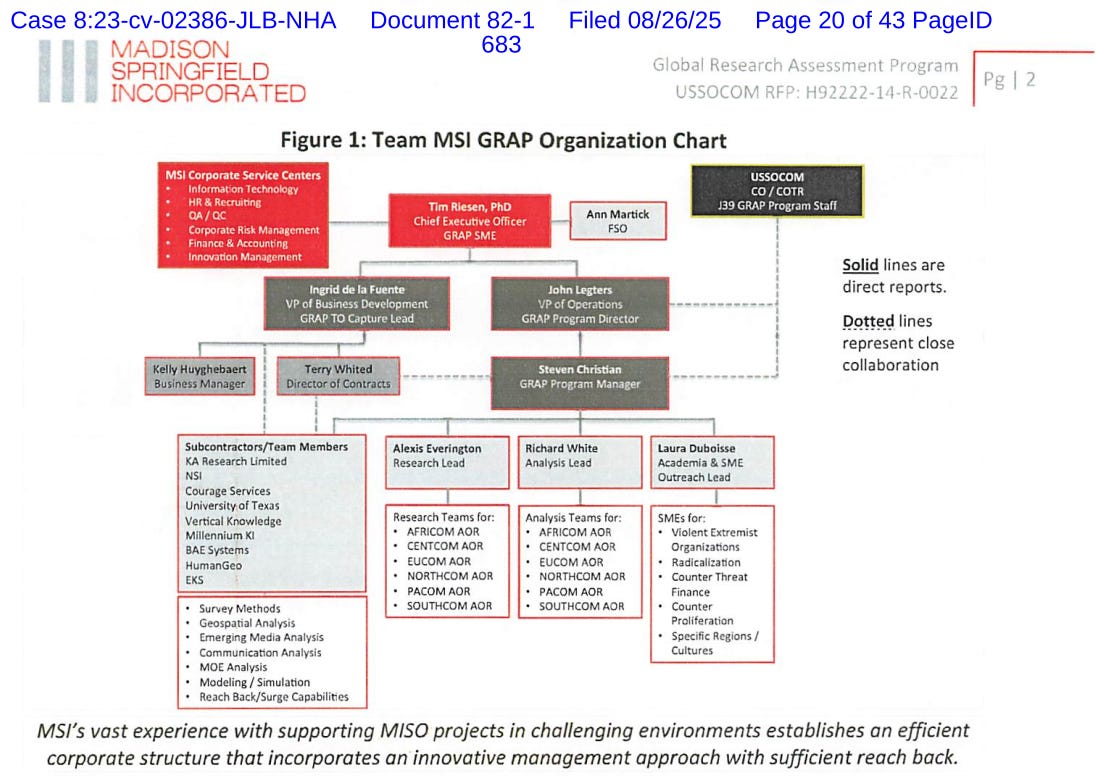
The 23 exhibits in the amended complaint span from photographs of Everington and White’s business cards as principals at MSI, to the full organization chart of MSI’s information warfare evaluation contract with SOCOM (“Global Research Assessment Program”), to numerous signed legal documents and group chats with MSI chief executive Timothy J. Riesen.
Public U.S. procurement records further detail MSI receiving nearly $5.5 million in subawards from U.S. Army Special Operations Command Europe through the McLean-based consulting firm Booz Allen Hamilton circa March 2018 to August 2020, including for “threat and intelligence analsysis [sic] and assessments, program support, operational influence platform, and training support.” MSI subsequently received an ongoing, roughly $23.5 million, more than 5-year contract through the office of the U.S. secretary of defense for GRAP-like information operation effectiveness assessments. The multi-year contract was given the acronym META, standing for “MISO Evaluation and Transregional Analysis,” with MISO itself being the acronym “Military Information Support Operations,” U.S. military jargon for propaganda / psychological operations.
The task orders under MSI’s META contract can be seen from the public summary to include: an “Internet-based MISO assessment framework,” a “Guyana Ghost Men assessment,” “[U.S. Special Operations Command South] baseline data ingestion,” an “Indo-Pacific MISO Assessment Program (IMAP) 2022,” and two recent “automated surveys” task orders relating to SOCOM’s Joint MISO Web Operations Center (JMWC).
As a whole, the exhibits published on Tuesday by Everington and White provide significant further context to the more than one-year process leading up to MSI’s ‘reverse triangular merger’ with Premise Data for an undisclosed amount in June 2022, through a special-purpose subsidiary of Premise named Ikaika, Inc.
(Exhibit 21 further includes a claim from Riesen that Premise executives, as of mid-May 2022, “haven't even told the Board of Directors about the deal. They are keeping it that close hold.”)
The amended complaint’s Exhibit 15 apparently concisely lays out the list of previous potential buyers for MSI, as of June 3, 2021, including: the most likely candidate of the Tysons-based Blue Delta Capital Partners, a three-way second-place tie between McNally Capital’s Orbis Operations, DC Capital’s Swift Group, and ASGN’s ECS Federal, and a third-place possibility of the “completely dysfunctional recent merger of Six Two Labs [sic] and IST Research” in the form of Carlyle Group’s Two Six Technologies.
(Premise Data was exclusively revealed by this publication in January of last year as a data provider to Orbis’s “Discovery” intelligence analysis product. Orbis rose to prominence earlier this year as a result of the company and its then-executive, former CIA special activities chief Philip F. Reilly, in the creation of the controversial Gaza Humanitarian Foundation and its primary private security partner, Safe Reach Solutions.)
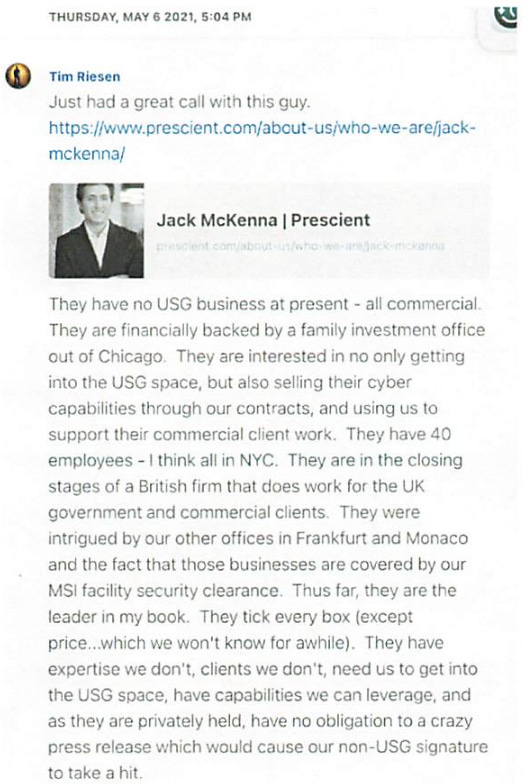
Exhibit 13 of Tuesday’s amended complaint further details a May 6, 2021 phone call between MSI chief executive Tim Riesen and Jack McKenna, the president and CEO of the Chicago-based private intelligence firm Prescient, regarding a possible merger of the two companies. “They [Prescient] are interested in no [sic] only getting into the USG space, but also selling their cyber capabilities through our contracts, and using us to support their commercial client work,” stated an image of a Wire message from Riesen to Everington.
Roughly four years prior to this conversation, Prescient was publicly listed as a parter of the “location-based intelligence” platform Project BlueGlass, which led to the creation of Geospark Analytics, now known as Seerist.
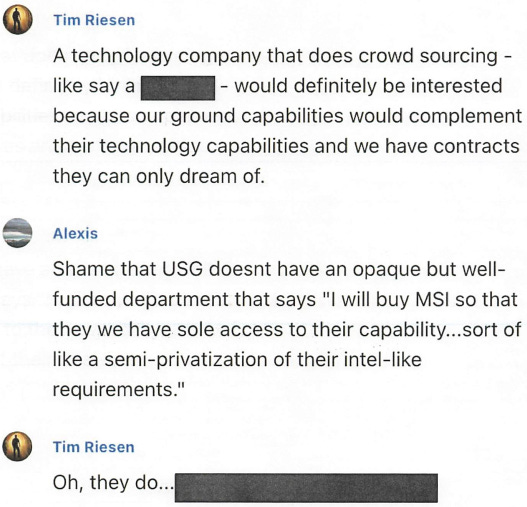
Another published Wire group chat session contains an exchange between Riesen and Alexis, dated May 6, 2021, regarding a redacted “technology company that does crowd sourcing” that “would definitely be interested” in acquiring MSI — almost certainly Premise Data. Riesen asserted that MSI’s “ground capabilities would complement their technology capabilities and we have contracts they can only dream of” before providing a redacted affirmation to Everington regarding the alleged existence of an “opaque” U.S. Government deparment for purchasing intelligence contractors such as MSI.
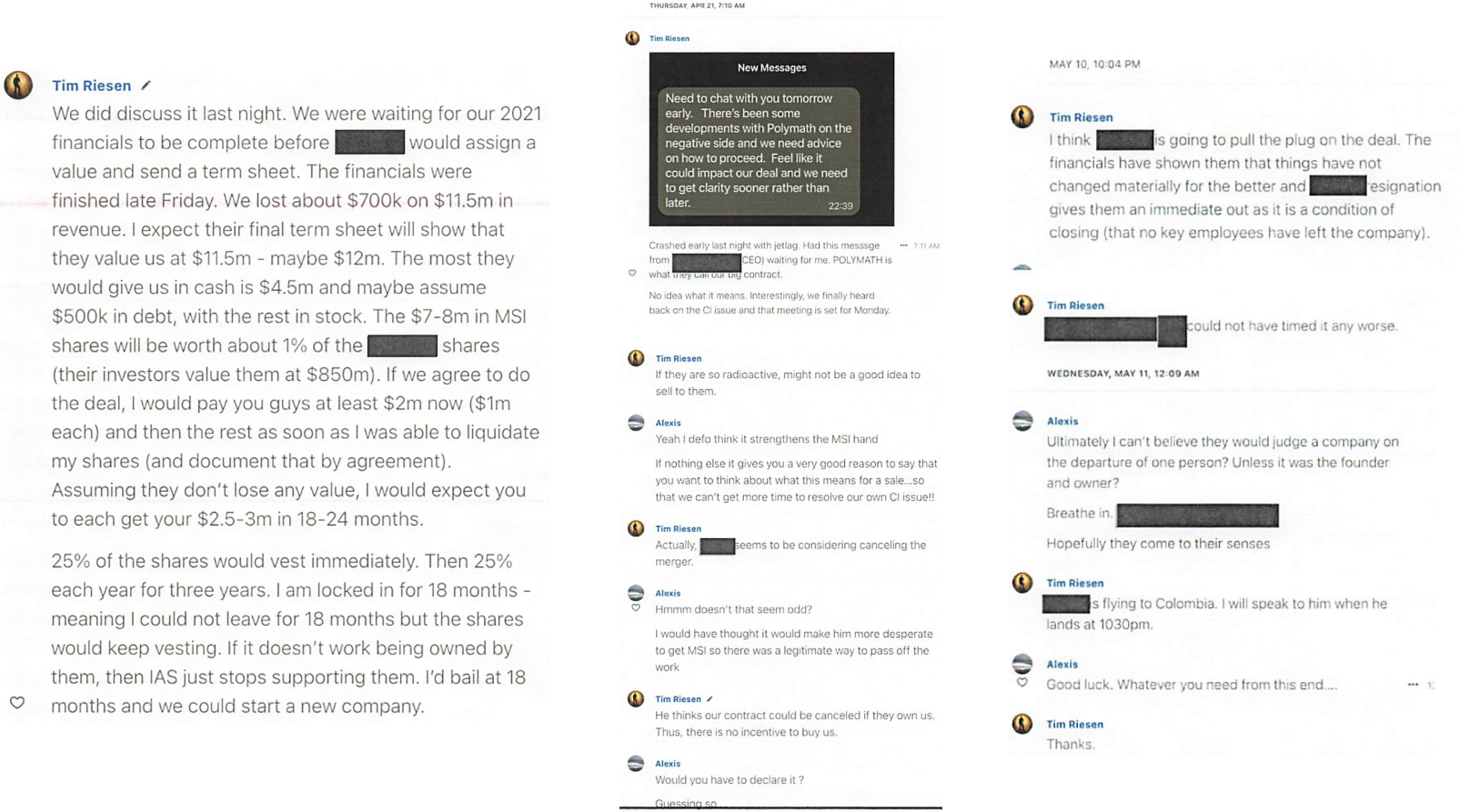
Another set of published Wire group chats, said to range from February to May 10, 2022, details the intense uncertainty during the final months before the closure of Premise’s acquisition of MSI. One exchange said to have taken place circa February 2022 includes the planned financial breakdown of MSI’s acquisition by Premise, with a total acquisition price between $11.5 million and $12 million, with between $7 million and $8 million in the form of stock.
A further April 21, 2022 exchange between Riesen and Everington contains a copy of a panicked text message from the previous night from the CEO of the redacted acquiring company — apparently Maury Blackman of Premise Data — cryptically stating that “There’s been some developments with Polymath on the negative side and we need advice on how to proceed.” Riesen clarified that “POLYMATH is what they call our big contract,” after noting that he had “crashed early last night with jetlag” and “had this message from [redacted] CEO waiting for me.”
Riesen subsequently conjectured that the redacted CEO’s concerns might relate to a “CI issue,” apparently referring to a potential counter-intelligence problem within Premise.
“If they [presumably Premise] are so radioactive, it might not be a good idea to sell to them,” Riesen argued. “He [presumably Blackman] thinks our contract could be canceled if they own us,” Riesen further stated, adding that “Thus, there is no incentive to buy us.”
A subsequent published exchange on Wire, dated May 10, 2022 beginning at 10:04 p.m. in an unspecified timezone, included fears from Riesen that a redacted individual — presumably Blackman — was “going to pull the plug on the deal” over the recent resignation of a redacted MSI employee. As revealed in a previous report from this publication, MSI president Ingrid de la Fuente — labeled in the GRAP org chart in Exhibit 9 as the company’s then-vice president of business development — completed her resignation from MSI just four days later, on May 14, 2022. Ms. Fuente subsequently filed a detailed False Claims Act suit against MSI with the central claim that the company fabricated timesheets with Everington and White in relation to a major multi-year contract with an unnamed U.S. agency, codenamed Beowulf. The case remains largely under seal, with one of the few unsealed documents containing Fuente’s voluntary withdrawal.
Beyond the question of whether MSI’s “Beowulf” contract relates to its GRAP work on information operations effectiveness assessments for U.S. Special Operations Command, it is unclear which contract “Polymath” was meant to refer to, as public contracting records to not appear to show Premise and MSI both operating under any particular contract around that time frame.
(According to a complaint filed by Fuente against MSI and Riesen in December 2023, MSI worked for the U.S. Government on Beowulf from August 2019 to September 2020, billing roughly $4.5 million and paying out $2.26 million to IAS by April 2020.)
Tuesday’s publication of Wire group chats again hint at the secretive role of the Monaco-based company set up by Everington and White as part of their collaboration with MSI between June 6, 2019 and October 31, 2022, Mare Nova SARL.
“I nearly threw in the towel after the misunderstanding involving the money that we had set aside for Mare Nova,” wrote Alexis in one of the communications in Exhibit 22, shortly following his receipt of a $1 million payment resulting from Premise’s acquisition of MSI. “I really REALLY want to avoid a situation like that from ever happening again,” Alexis added, before arguing that the best way to avoid a similar confusion in the future was “for us all to share the [acquisition] documents so that we are on the same page.”
“You guys seem disappointed in getting $2m plus another $4m down the road,” responded Riesen, before concluding, “That a deal happened at all with our financials is a miracle.”
If Ms. Fuente is correct, the two hucksters from MSI, Everington and White committed fraud to dress up the volume of work MSI had and pad MSI's financial statements - this should be interesting as it plays out.